

Jean Cocteau’s Beauty and the Beast, costumes by Pierre Cardin

.
Short Biography

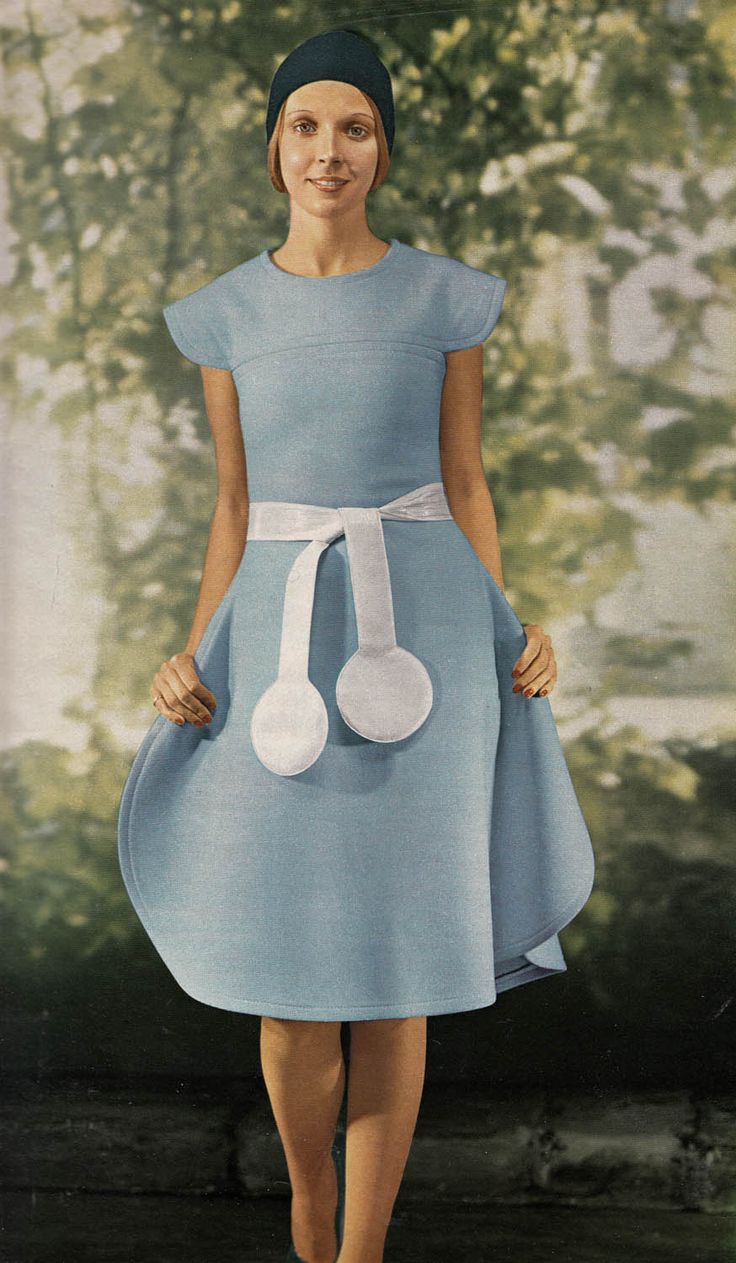
 A Pierre Cardin Bubble Dress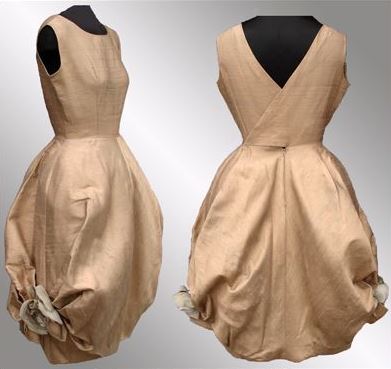
Soon, though, Cardin was looking outside France for inspiration. He visited Japan in 1957, becoming one of the first Western designers to seek out Eastern influences. In Japan, he scoped out business opportunities while studying the country’s fashions for new ideas. The Japanese fashion school Bunka Fukusoi made him an honorary professor, and he taught a one-month class there on three-dimensional cuts. Also in 1957, Cardin opened his first boutique for men in Paris, called Adam.
In 1959, he was expelled from the Chambre Syndicale for launching a ready-to-wear collection for the Printemps department store as the first couturier in Paris, but was soon reinstated.
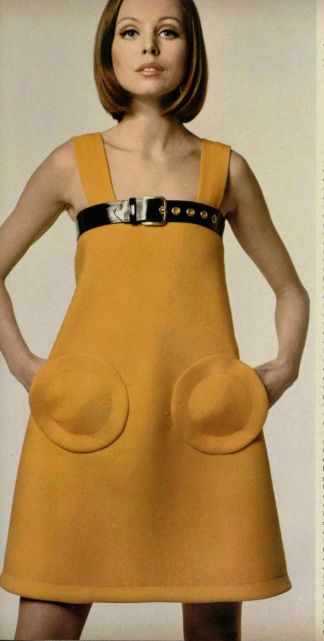
Circles in Pierre Cardin’s Fashion Designs

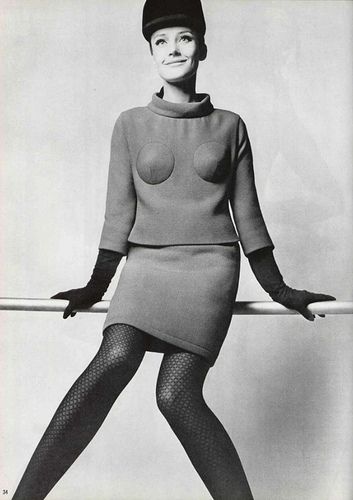
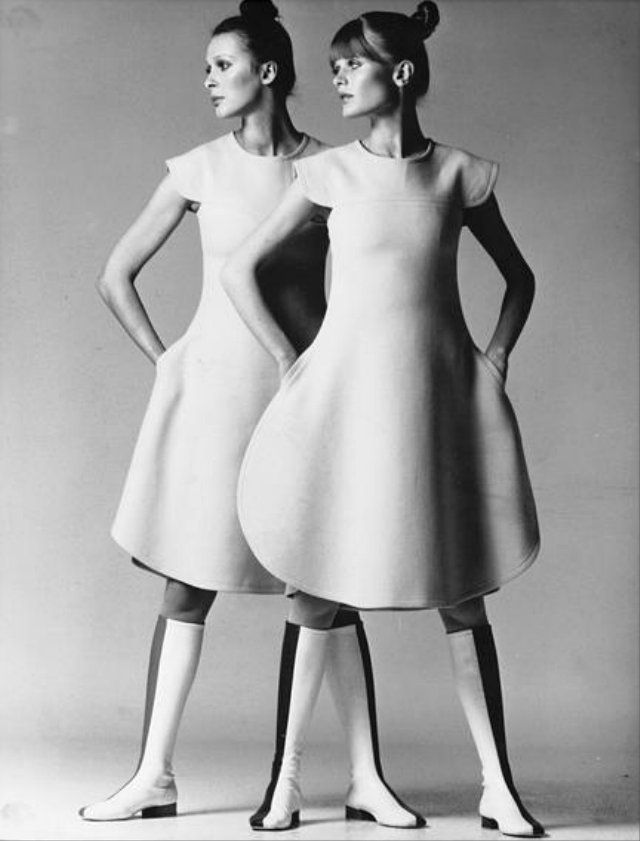


During the 1960s, Cardin began a practise that is now commonplace by creating the system of licenses that he was to apply to fashion. A clothing collection launched around this period surprised all by displaying the designer’s logo on the garments for the first time.
.
Cardin resigned from the Chambre Syndicale in 1966 and began showing his collections in his own venue, the “Espace Cardin” (opened 1971) in Paris, formerly the “Théâtre des Ambassadeurs”. The Espace Cardin is also used to promote new artistic talents, like theater ensembles, musicians, and others. He was also contacted by Pakistan International Airlines to design uniforms for the flag carrier. The uniforms were introduced in 1966 to 1971 and became an instant hit.
Uniforms for Paskistan International Airlines
.

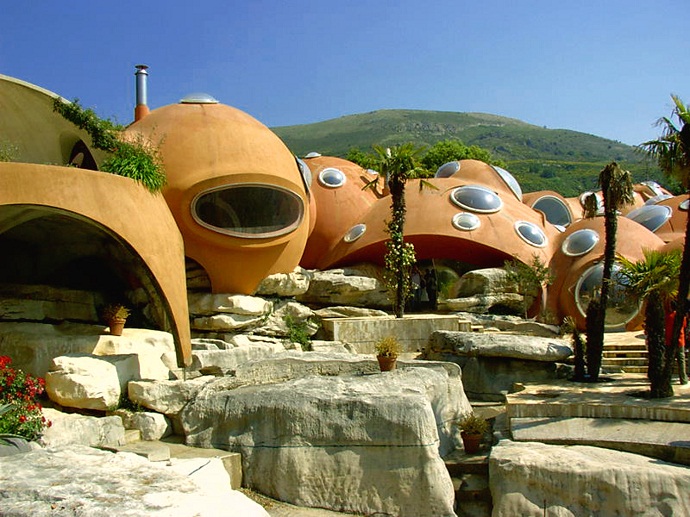
The Bubble House


Cardin bought Maxim’s restaurants in 1981 and soon opened branches in New York, London, and Beijing (1983). A chain of Maxim’s Hotels are now included in the assets. He has also licensed a wide range of food products under that name..
Like many other designers today, Cardin decided in 1994 to show his collection only to a small circle of selected clients and journalists. After a break of 15 years, he showed a new collection to a group of 150 journalists at his bubble home in Cannes.





.
.
Books

Pierre Cardin: Fifty Years of Fashion and design
This is the first authorized monograph on Pierre Cardin (b. 1922). Visionary fashion designer and licensing pioneer, Cardin began his career apprenticed to Elsa Schiaparelli and Christian Dior. He quickly launched his own haute couture line, in 1954, followed rapidly by the first women’s and men’s prêt-à-porter (ready-to-wear) collections from a couture designer. Since the 1960s, Cardin’s cutting-edge, futuristic designs have continually broken new ground and established exciting new trends. And he invented the business of fashion as we know it today, with international brand licensing across a variety of products and media. Pierre Cardin himself made his ambition clear: “I wanted my name to become a brand and not just a label.”
Cardin brought high fashion to the street; he invented the bubble dress and launched the use of cartridge pleating, bright clear colors, as well as vinyl, plastics, metal rings, and oversize buttons. Pierre Cardin has also designed accessories, furniture, and cosmetics. There are now more than 900 licenses in over 140 countries, employing more than 200,000 people under the Pierre Cardin trademark.
.

Pierre Cardin: 60 Years of Innovation
The Cardin fashion house celebrated its 60th anniversary in 2010, an occasion that called for a retrospective of the work of its founder, designer Pierre Cardin. Born in 1922 in Sant’Andrea de Barbarana, Venice province, Pierre Cardin immigrated to Paris in 1924 with his parents, who were thrown into poverty by World War I. After working briefly with Elsa Schiaparelli, Cardin joined Dior in 1946 and opened his own couture house in 1950.
He was a pioneer from the start, creating a design-based, architectural fash ion with a futurist sensibility. Cardin also had a pioneer’s understanding of fashion’s relationship to new audiences, presenting his collections to large crowds. He was the first to demonstrate that fashion can be both a creative process and a business – and that one man can excel as both a business man and an artist.
This volume is a tribute to an iconoclastic – and now iconic – designer, entrepreneur, and visionary.


info: http://www.whatgoesaroundnyc.com/blog/12540 & Wikipedia


 agnautacouture.com
Glorious. Thank you.
Pierre Cardin did NOT design the costumes for Jean Cocteau’s “La Belle et la Bete.” Christian Berard did the initial design sketches, and, with Marcel Escoffier, came to the House of Paquin to make the costumes. Antonio Castillo, the head designer of Paquin at the time, made Belle’s Negligee as a condition to get his name and the House of Paquin in the credits. Nowhere in the credits of the film will you even find Pierre Cardin. Nowhere in Jean Cocteau’s “Beauty and the Beast: Diary of a Film” will you see any mention of Cardin.
Pierre Cardin was a TAILOR at Paquin. He helped CONSTRUCT the costumes. Since actor Jean Marais was in Switzerland at the time the costumes for were made, the costumes were modeled by the only male in the place that was available at the time, Cardin. Adjustments had to be made to the costumes thereafter, as Cardin was a different body type than Marais.
Over the years, Cardin exaggerated his role with regard to the costumes. After Marais’ death in 1996, Cardin went full in and claimed to have “designed costumes and masks for La Belle et la Bete” on his website. After his death, that claim was removed. I HAVE A SCREEN SHOT OF THIS!
Jean Marais credits Christian Berard for the costumes, and hairpiece maker for the Paris Opera, Raymond Pontet for the 3-part mask. Jean Cocteau credits Christian Berard for the costumes, with assistance of Marcel Escoffier.
Sources:
Jean Marais, “Histoires de ma Vie” (Albin Michel publisher, Paris, 1975, pp 174-182)
Jean Cocteau, “Beauty and the Beast: Diary of a Film, ” (translated by Ronald Duncan, Dover Publications, NY, 1972, pp 6, 20, 96)
Richard Morais,”pierre cardin: The Man Who Became a Label,” (Transword Publishers, LTD, London, 1991, pp 36-41). (and yes, the name Pierre Cardin is in lower case in the title.)
Please correct this mis-attribution! Let’s not add to the misinformation out there!